







Comics
I'm always exploring new creative projects. My current one is a new graphic novel that combines my love of writing and drawing. More on that later, when I have something ready to show. Meanwhile, here are my portraits of three real-life people who served as inspiration for characters or events in Resurrection Kill.
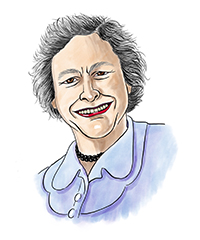 Meet
Dr. Frieda Fromm-Reichmann (1889 - 1957). A German psychiatrist and contemporary of Sigmund Freud, she immigrated to America
during World War II. She invented the concept of the "schizophrenogenic mother," theorizing that psychological disorders
stem from mothers who neglected, overprotected, or otherwise mistreated their children. Her legacy is generations of
moms getting blamed for all their kids' problems. Dr. Emma Koffka is her fictional counterpart in Resurrection Kill.
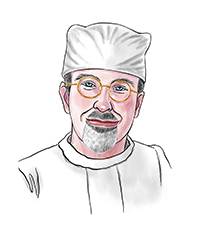 And then
there's Dr. Walter Jackson Freeman (1895 - 1972), a neurologist who popularized the use of lobotomy for psychiatric
patients. His infamous form of lobotomy involved hammering an instrument that resembled an icepick through the eye
socket into the brain. He traveled around the country, performing (sometimes fatal) lobotomies on thousands of
patients. In Resurrection Kill, he struts his stuff as Dr. Bradley Buscher (a.k.a. Dr. Brain-Butcher).
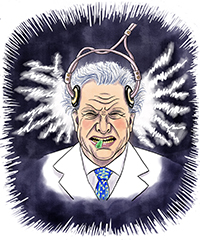 Last
but not least is Dr. Ugo Cerletti (1877 - 1963), nominated for the Nobel Prize for his pioneering development of
electroconvulsive therapy, a.k.a. shock treatment. While ECT nowadays can be an effective treatment for disorders
that are resistant to other therapies, during the early years it was unregulated, primitive science that often caused
brain damage. Characters in Resurrection Kill were the unfortunate recipients of recklessly deployed shock treatment.
Here, I gave Dr. Cerletti a taste of his own medicine.
___________________
My first attempt at graphic novels was Sylvia Plath, my graphic biography of the iconic poet.
Set in 1953, it encompasses her tumultuous summer in New York City, which led to an emotional breakdown,
her first suicide attempt, and a harrowing journey through mental hospitals. Between legendary episodes
from that watershed period, the story flashes back in time to Plath's past and forward into her future.
Sylvia Plath is a tapestry of her major life events, woven upon the warp of the true story behind her
famous novel, The Bell Jar.
This is an excerpt from the beginning.


___________________
A Guide to Victorian Death Rites is my minicomic about death customs in the Victorian era. The Victorians really knew how to do death, which was a good thing. Before the advent of modern medicine, life was precarious. It was here today, gone tomorrow, on a massive scale. Here are some of the ways the Victorians honored and memorialized their dear departed.


